


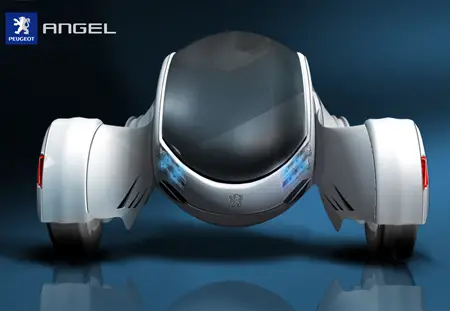
Peugeot Concept Car with Image 8
This design peugeot concept car look high modern technology because this car use for future. i think this peugeot car is very futuristic car, beautiful and cool car.
Concept Car, Peugeot
 Unique Design 3ds Max concept car
 Cool Modern Design 3ds Max concept car with Red Color
 3ds Max concept car in Front
 3ds Max concept car in Beside
 Design 3ds Max concept car Ideas
 Modern Design porche 3ds Max concept car
 Cool Design 3ds Max concept car with Silver Color
 BMW 335is Coupe 2011 - Red - Rear Angle View 2011 BMW 335is Cabriolet - Blue - Rear Angle View BMW 335is Cabriolet 2011 - Blue - Front Angle View


However, unlike the sporty Kadett that combined exclusive styling cues with performance enhancements, the Corsa Color Race's upgrades are limited to cosmetic upgrades.
 The three-door Color Race is available with a choice of three exterior finishes - Sunny Melon Yellow color, Casablanca White and Magma Red- and comes with a standard black hood as well as side and tailgate appliqués with a checkered flag motif, black painted roof and black 17-inch alloy wheels.The special edition model's interior features matching color highlights such as special seat stitching and vent bezels, a Panorama sunroof and a leather-clad steering wheel.
The Corsa Color Race is offered with the same range of engines as the other 2010 Corsa models including the new 1.4-liter gasoline unit with 87HP or 100HP and the 130HP 1.7-liter CDTI turbo diesel that returns a combined fuel consumption of just 4.5-liter per 100 km or 52.3 mpg US.
Pricing in Germany starts from €15,560 or at today's exchange rates, approximately US$22,500.
Via: Autogespot and Chickslovethecar


 And while the builder shortened the length of the car shell to fit the table, both the front and rear ends are the same size as the original 'Stang and feature working lights, chrome decals and bumpers.
The maker of the '65 Mustang pool table, 'Mustang Entertainment Inc.' plans to debut its newest product at next month's Barret-Jackson Auto Auction (Jan. 18, 2010 - Jan. 24, 2010).
The problem with the 1965 Mustang pool table, which by the way, is an official licensed product, is its price that will set you back a hefty $14,995. If you're still interested, the pool table can be ordered either online or over the phone by calling 727.827.8268.


The updated Lion, which is now three-dimensional and looks more dynamic and supple, will make its vehicle debut on the new Peugeot RCZ sports coupe launched in the Spring. If you hit the jump, you can read about the birth and the evolution of the Lion emblem from 1847 to today.
From Peugeot Press Release:
 The origin of the Lion
The Lion emblem was first conceived in 1847 when Jules and Emile PEUGEOT, who founded the company Peugeot Frères, asked Julien BLAZER, a jeweller and engraver, to produce a logo for identifying all PEUGEOT products.
The chosen design was a Lion, as the characteristics of the Lion were very similar to those of the saws the Peugeot brothers were producing:
Strong teeth like those of the Lion.
Suppleness of the blade like the Lion's spine.
Swiftness of cut like the Lion pouncing on its prey.
The Lion quickly became Peugeot's sole registered trade mark, and could be found not only on tools and saw blades, but also on coffee grinders by 1881 (the production of which began in 1840), on bicycles from 1882 and, from 1898, on motorcycles.
Although the first Peugeot production car the Type 3, built by Armand PEUGEOT dates from 1891, it was only in 1906 that the emblem first appeared on a production car.
In 1910, the two entities (PEUGEOT Frères and Armand PEUGEOT) merged to become La Sté des automobiles et cycles PEUGEOT; the two product ranges, however, co-existed until the First World War.
The last car to display the "Lion walking on an arrow" was the Bébé Lion (designed by Ettore Bugatti), presented at the Paris Motor Show in October 1912.
 Subsequent models, however, used old-style lettering, on the top of the radiator grille contained inside a double "ellipse", and in some instances with lettering also on the radiator, either on its own or in a coat of arms (from the 201).
In the 1920s the Lion became a rallying call for "Peugeotistes" who used it as a decoration on their radiator caps. Two types of radiator Lions were distributed in the network, a roaring version by the sculptor Marx and one ready to pounce by Baudichon.
 For its part, Peugeot bicycles and motorcycles first used the Lion "walking on an arrow" emblem against the background of a spoked wheel; later a fighting Lion facing to the right was introduced in the 1920s and, finally, the same design but with upright lettering in 1960. Tools and domestic appliances opted for the Lion "walking on an arrow" in a coat of arms or on an oval plaque for coffee grinders.
From October 1933, with the launch of the "aerodynamic" range of Peugeot vehicles 201, 301 and 601, a Lion's head re-appeared on the top of the radiator grille.
T his design also appeared on the 401, first seen at the 1934 Paris Motor Show and with a tapered head design on the 402 (1935) then the 302 (1936) and the 202 in 1938.
In 1948, the 203 adopted as its figurehead a Lion on the bonnet in a more prominent style. With the launch of the 403 in 1955 another new Lion appeared on the bonnet, however, these two designs were deemed too dangerous in the event of a collision and soon disappeared in September 1958.
 The launch of the 203 also marked the first appearance of the heraldic Lion of Franche-Comté and the Duchy of Montbéliard.
It was attached to the boot lid until October 1952 and then migrated to the front of the bonnet from September 1958 until the end of the series in February 1960. During this period the heraldic Lion also appeared on PEUGEOT motorcycles.
The same design of the Lion was also placed in a small coat of arms in the centre of the radiator grille on the 403 range from April 1955 to 1966 before being replaced by a larger version, which first appeared on the Pininfarina styled 404, in May 1960.
It was then replaced by a Lion (gilt or chrome-plated) leaping from its background, which first appeared in September 1968 on the 504, then was adopted by the 404, 204, 304 and 104.
 Another generation, the Lion "in outline" appeared on the 604 marketed in September 1975, and then extended to the 305 (November 1977) and 505 (May 1979) before being presented on a black background in 1982 on the 205, through to the 306 in 1993.
 At its launch in October 1995, the 406 stood out with its large Lion emblem which rapidly migrated across the entire "six" generation models. This led in 1998 to a new look Lion, with a stylised, angular appearance that decorated the front and rear of both Peugeot cars and scooters.
 Now in 2010, the Peugeot Lion, which has been associated with the brand for the last 152 years, has evolved again with a new more dynamic look. Combining a new bi-metallic finish it is now simpler in design, with a new posture and fluidity. The first production vehicle to display this new Lion will be the Peugeot RCZ which will be launched in April.


